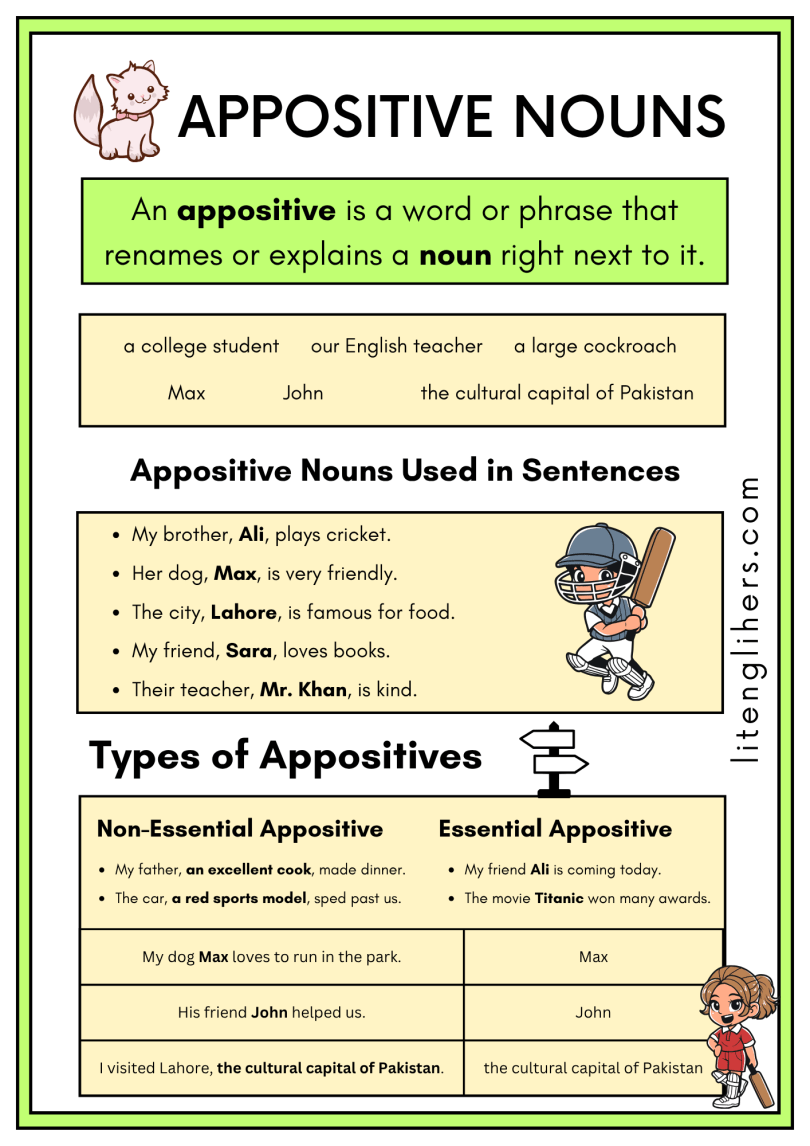
In English grammar, appositive nouns help us explain or give more information about another noun. This makes your sentences clearer, more informative, and more natural.
In this article, you will learn:
- What an appositive noun is
- Types of appositives (essential & non-essential)
- Easy examples and rules for using appositives
- How to use them in daily conversation and writing
What is an Appositive Noun?
An appositive noun is a noun or noun phrase that comes right next to another noun and gives more information about it.
Simple Definition:
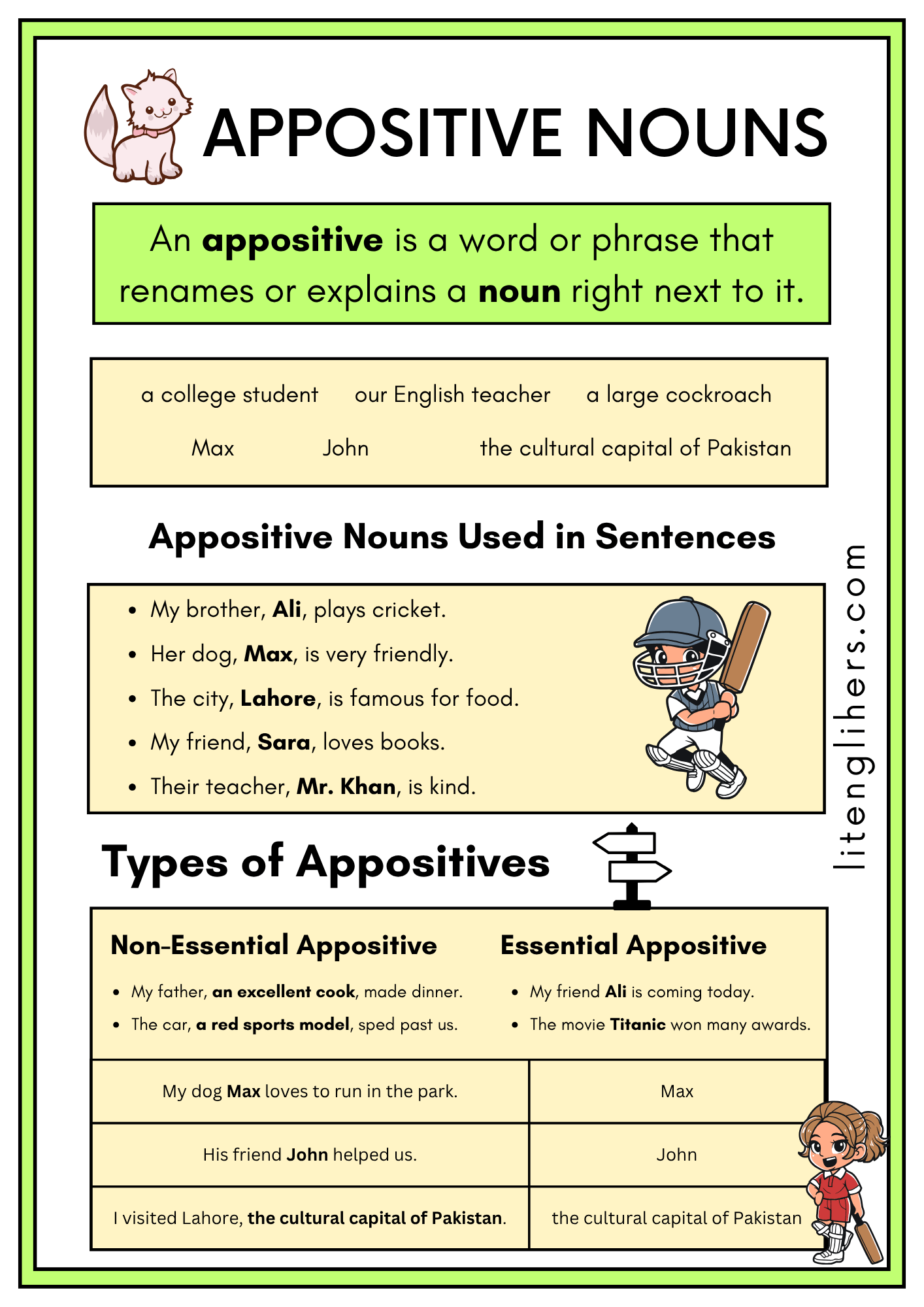
An appositive is a word or phrase that renames or explains a noun right next to it.
Examples of Appositive Noun:
My brother, a doctor, lives in London.
→ “a doctor” is the appositive. It tells us more about “my brother.”
Paris, the capital of France, is a beautiful city.
→ “the capital of France” is the appositive. It explains what “Paris” is.
Appositive Nouns
Structure of Appositive Nouns
- Main Noun + Appositive
Sometimes separated by commas, sometimes not (we’ll explain below).
Types of Appositives
There are two main types of appositives in English:
1. Non-Essential Appositive (also called non-restrictive)
- Adds extra information
- Separated by commas
- You can remove it, and the sentence still makes sense
Examples:
- My father, an excellent cook, made dinner.
- The car, a red sports model, sped past us.
2. Essential Appositive (also called restrictive)
- Gives necessary information
- Not separated by commas
- You cannot remove it without changing the meaning
Examples:
- My friend Ali is coming today.
- The movie Titanic won many awards.
Appositive Examples in Sentences
| Sentence | Appositive |
|---|---|
| My cousin, a college student, studies hard. | a college student |
| Mr. Brown, our English teacher, is absent today. | our English teacher |
| The insect, a large cockroach, ran under the sofa. | a large cockroach |
| My dog Max loves to run in the park. | Max |
| His friend John helped us. | John |
| I visited Lahore, the cultural capital of Pakistan. | the cultural capital of Pakistan |
Why Use Appositive Nouns?
- To give extra details in a short way
- To rename or explain who or what a noun is
- To avoid repeating the same noun again
- To make your writing clearer and more fluent
Punctuation Tip
| Type | Use Comma? | Example |
|---|---|---|
| Non-essential | ✅ Yes | My friend, a good artist, drew that sketch. |
| Essential | ❌ No | My friend Sara is in the kitchen. |
Summary
- An appositive noun gives more information about a noun.
- It can be essential (no commas) or non-essential (with commas).
- It makes your speaking and writing better and clearer.
- Use appositives to rename, explain, or identify someone or something.
Read More