Nouns are important parts of every English sentence. They can work as the subject or the object to show who does something or who gets something. We also use nouns with articles like a, an, and the, and with determiners to give more meaning. In this blog post, you will learn how nouns work in sentences in a simple and clear way to make your English better.
Nouns in Sentences
A noun is a word that names a person, place, thing, or idea. In sentences, nouns play important roles. They help us understand who is doing something, what is happening, and to whom it happens.
Example:
- The boy kicked the ball.
- boy and ball are nouns.
Subject Nouns
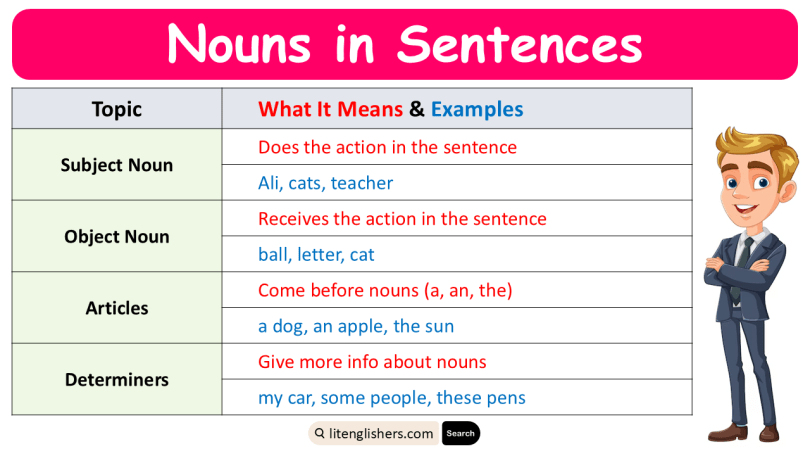
Subject nouns tell us who or what does the action in a sentence. The subject noun usually comes before the verb.
Examples:
- Ali plays football. (Ali is the subject noun.)
- Cats sleep all day. (Cats is the subject noun.)
- The teacher explained the lesson. (teacher is the subject noun.)
Tip:
Always look for the doer of the action — that is the subject noun.
Object Nouns
An object noun tells us who or what receives the action in a sentence. The object usually comes after the verb.
Examples:
- Ali kicked the ball. (ball is the object noun.)
- She wrote a letter. (letter is the object noun.)
- The dog chased the cat. (cat is the object noun.)
Tip:
The object noun answers the question “what?” or “whom?” after the verb.
Nouns with Articles (a, an, the)
Articles are small words that come before nouns. They help show whether we are talking about something specific or general.
- a → for any one of something (general, starts with a consonant sound)
a cat, a book, a teacher - an → for any one of something (general, starts with a vowel sound)
an apple, an egg, an umbrella - the → for a specific thing
the cat, the book, the teacher
Examples:
| Article | Noun Phrase |
|---|---|
| a | a dog |
| an | an orange |
| the | the sun |
- Use a/an for general things
- Use the for something you know or have already talked about
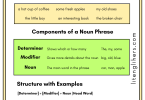
Nouns and Determiners
Determiners are words that come before nouns to give more information. Articles (a, an, the) are one type of determiner, but there are other determiners too:
Common determiners:
- my, your, his, her, our, their
my car, your dog, her book - some, many, few
some people, many students, few apples - this, that, these, those
this chair, those cars, these pens
Examples in sentences:
- My sister is a doctor.
(“my” is a determiner showing whose sister.) - Some children are playing.
(“some” shows an amount.) - These flowers are beautiful.
(“these” shows which flowers.)
Tip:
A determiner always comes before a noun.
Nouns are the building blocks of sentences. You can use them as subjects (who does the action) or objects (who receives the action). Articles and determiners help give more detail about the nouns.
Keep practicing these rules to make your English stronger and clearer!
Read More