Do you know what we call a group of people, animals, or things in English? Instead of using words like many or lots, we use special words called collective nouns. In this blog post, you will learn what collective nouns are, explore their types, and see 100 examples to help you understand clearly.
What Are Collective Nouns?
A collective noun is a word used to describe a group of people, animals, or things as one single unit.
- A team of players won the match.
- A flock of birds flew away.
- A bundle of sticks was on the ground.
These are not plural words, but they refer to many as a single group.
Types of Collective Nouns
We can divide collective nouns into three common types:
- People Group Nouns
- Animal Group Nouns
- Thing/Object Group Nouns
Let’s now look at each type with 30 simple examples for easy learning.
1. Collective Nouns for People
These nouns are used for groups of people doing something together.
| Collective Noun | Used For |
|---|---|
| Team | Group of players |
| Crew | Group working on a ship or plane |
| Staff | Workers in one company |
| Family | People related by blood |
| Class | Students together |
Examples of People Group Nouns
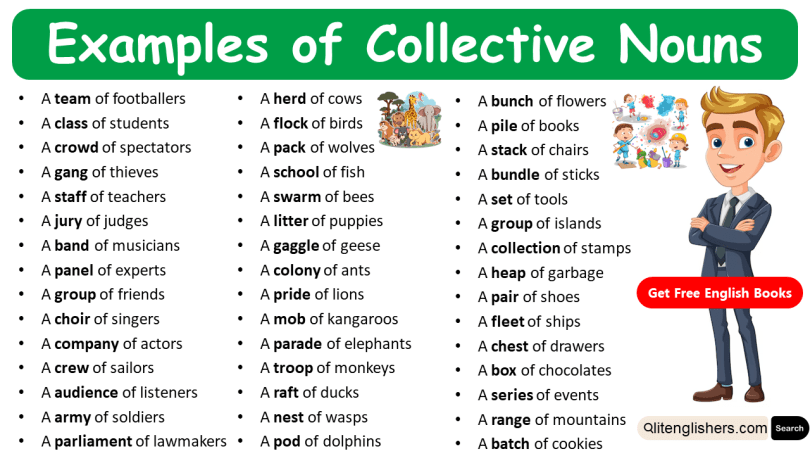
- A team of footballers
- A class of students
- A crowd of spectators
- A gang of thieves
- A staff of teachers
- A jury of judges
- A band of musicians
- A panel of experts
- A group of friends
- A choir of singers
- A company of actors
- A crew of sailors
- A audience of listeners
- A army of soldiers
- A parliament of lawmakers
- A cast of actors
- A board of directors
- A host of guests
- A committee of members
- A division of soldiers
- A troop of scouts
- A line of dancers
- A staff of nurses
- A gathering of people
- A posse of police
- A delegation of leaders
- A network of professionals
- A club of readers
- A team of doctors
- A formation of cadets
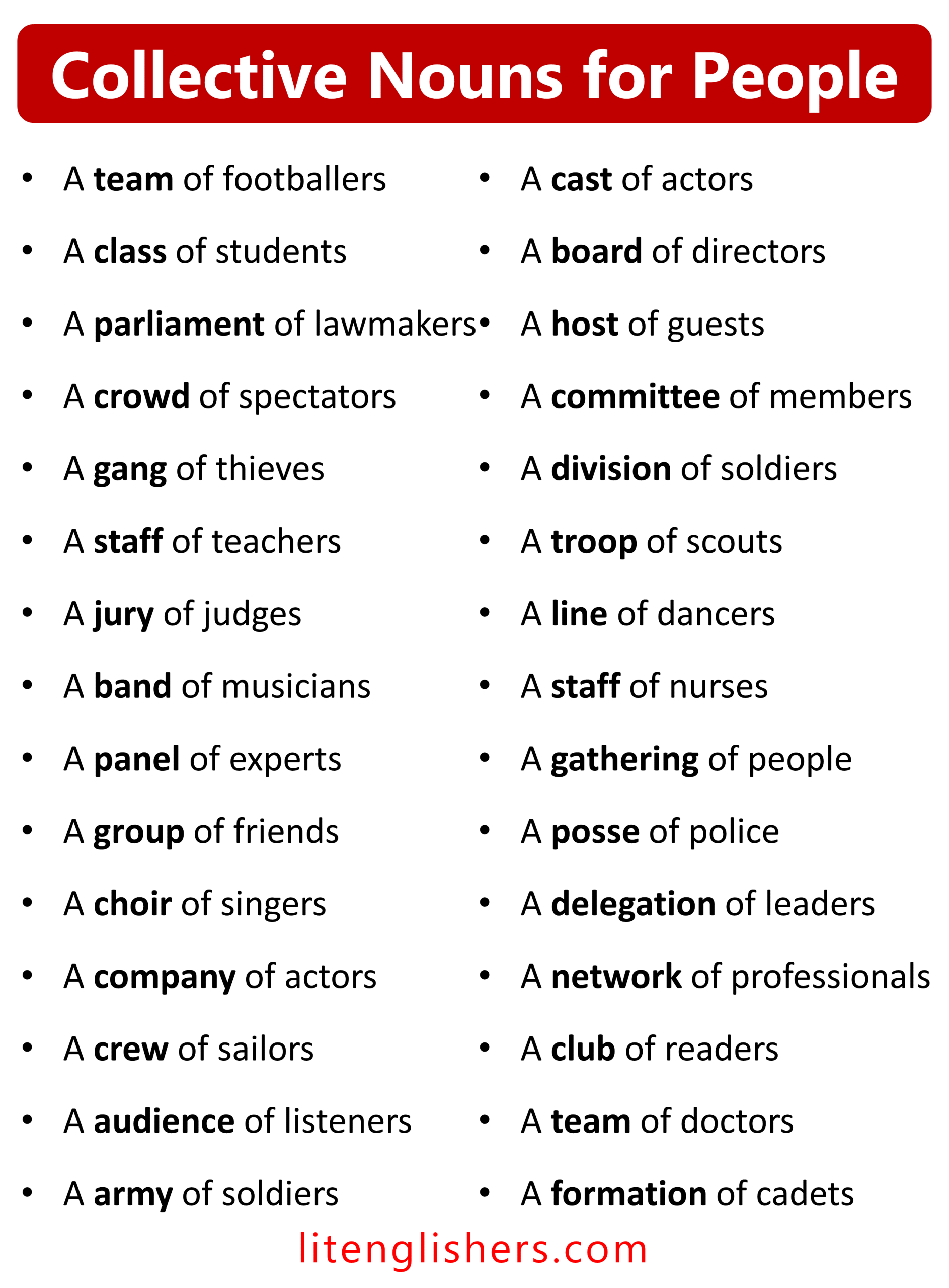
Collective Nouns for People
2. Collective Nouns for Animals
Used when we talk about groups of animals, same or different kind.
| Collective Noun | Used For |
|---|---|
| Herd | Group of cows, deer, etc. |
| Flock | Birds or sheep |
| Pack | Wolves, dogs |
| Swarm | Bees, flies |
| School | Fish |
Examples of Animal Group Nouns
- A herd of cows
- A flock of birds
- A pack of wolves
- A school of fish
- A swarm of bees
- A litter of puppies
- A gaggle of geese
- A colony of ants
- A pride of lions
- A mob of kangaroos
- A parade of elephants
- A troop of monkeys
- A raft of ducks
- A nest of wasps
- A pod of dolphins
- A drove of cattle
- A leap of leopards
- A tower of giraffes
- A horde of insects
- A bale of turtles
- A sounder of pigs
- A business of ferrets
- A clowder of cats
- A team of horses
- A string of ponies
- A pack of hounds
- A murder of crows
- A cackle of hyenas
- A kettle of hawks
- A charm of hummingbirds
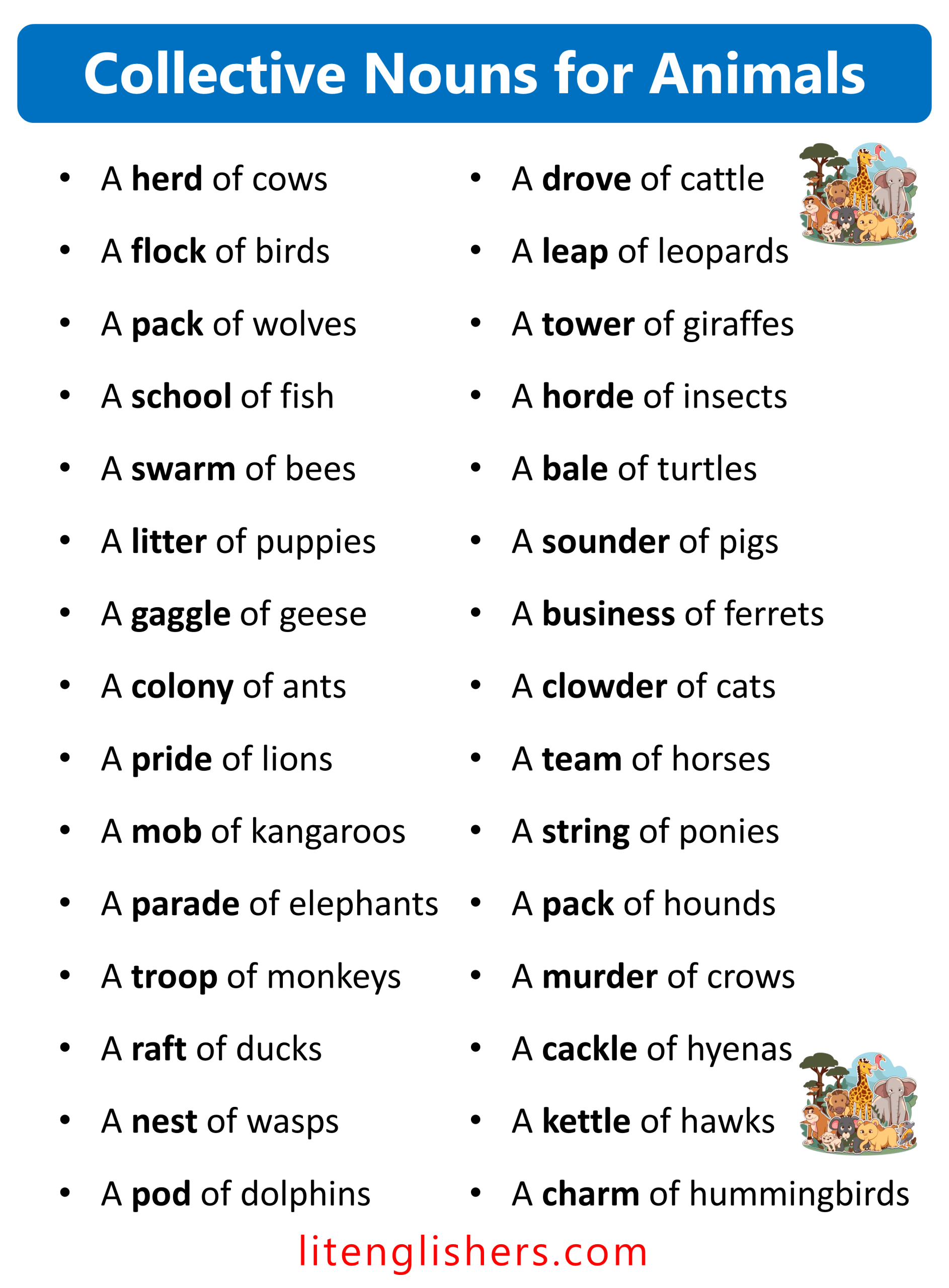
Collective Nouns for Animals
3. Collective Nouns for Things/Objects
Used when we talk about groups of items or objects.
| Collective Noun | Used For |
|---|---|
| Bunch | Flowers, grapes |
| Pile | Books, papers |
| Stack | Chairs, boxes |
| Set | Tools, cutlery, dishes |
| Collection | Stamps, coins, paintings |
Examples of Thing/Object Group Nouns
- A bunch of flowers
- A pile of books
- A stack of chairs
- A bundle of sticks
- A set of tools
- A group of islands
- A collection of stamps
- A heap of garbage
- A pair of shoes
- A fleet of ships
- A chest of drawers
- A box of chocolates
- A series of events
- A range of mountains
- A batch of cookies
- A clump of trees
- A cluster of stars
- A line of cars
- A stream of data
- A deck of cards
- A roll of paper
- A row of houses
- A batch of letters
- A load of laundry
- A library of books
- A album of photos
- A basket of fruits
- A tray of glasses
- A carton of eggs
- A fleet of airplanes
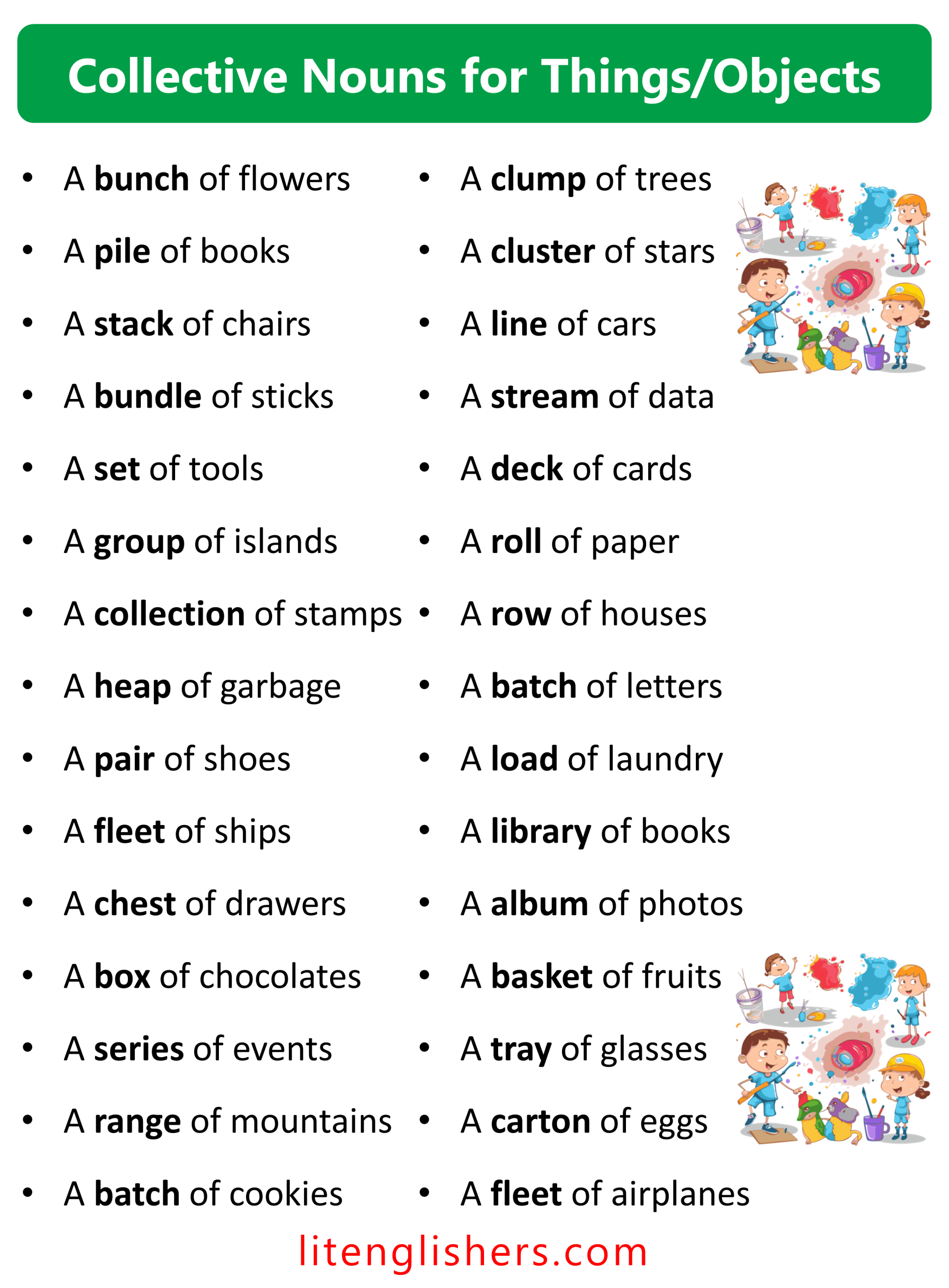
Collective Nouns for Things or Objects
Use in Different Contexts
Sometimes one collective noun can be used in different ways.
➡️ A team of doctors (People)
➡️ A team of horses (Animals)
➡️ A group of dancers (People)
➡️ A group of islands (Things)
So, context tells us what kind of group the word is talking about.
Collective Nouns help us to talk about many things or people in one word. They make our sentences shorter, clearer, and more natural in English. Learning these words will help you speak and write more like a native English speaker. Practice these examples every day to get better!
Read More