Have you ever wondered whether you should say “my apology” or “my apologies” when expressing regret?
Many English learners and even native speakers use these phrases interchangeably. However, they are not always used in the same way. Understanding the difference can help you sound more natural, professional, and grammatically correct in conversations, emails, and formal writing.
In this guide, you’ll learn the meaning of both expressions, when to use them, common examples, and the difference between apologise and apologize.
My apology vs. My apologies—When to say each phrase
Although both expressions relate to regret and taking responsibility for a mistake, they serve different purposes in English.
| Phrase | Meaning | Common Usage |
|---|---|---|
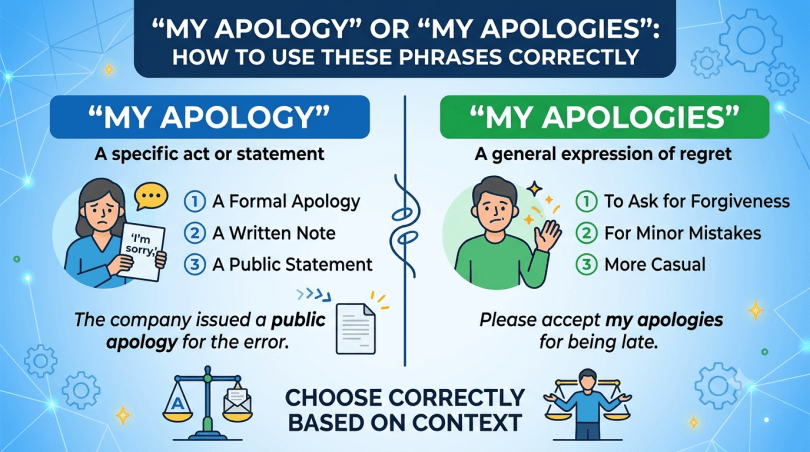
| My apology | Refers to a specific apology or act of apologizing | Formal writing and specific situations |
| My apologies | A polite way to say “I’m sorry” | Everyday conversations, emails, and professional communication |
The phrase “my apologies” is much more common in modern English. It functions as an expression of regret and is often used instead of saying “I’m sorry.”
On the other hand, “my apology” usually refers to a particular apology that someone has made or offered.
When to say “my apology” and when to say “my apologies”
Use “my apology” when discussing a specific apology as a noun.
Examples include:
- Referring to an apology letter
- Mentioning an apology you previously made
- Discussing a formal apology
Use “my apologies” when directly expressing regret to someone.
Examples include:
- Arriving late to a meeting
- Sending incorrect information
- Interrupting someone during a conversation
- Missing an appointment
“My apology” in a sentence
- Please accept my apology for the misunderstanding.
- My apology was included in the official statement.
- The manager issued my apology to the customer.
- I hope my apology helps repair our relationship.
“My apologies” in a sentence
- My apologies for the delay in responding.
- My apologies, I didn’t see your email.
- My apologies for the confusion caused.
- My apologies for interrupting your presentation.
“My apologies” meaning
The phrase “my apologies” means “I am sorry” or “I regret what happened.”
It is considered a polite and professional expression that acknowledges a mistake, inconvenience, or misunderstanding. In business communication, many professionals prefer saying “my apologies” because it sounds courteous and respectful.
Why is “my apologies” so common?
There are several reasons:
- It sounds professional.
- It expresses accountability.
- It works in both spoken and written English.
- It is suitable for formal situations.
Common situations include:
- Customer service responses
- Workplace communication
- Professional emails
- Public statements
- Everyday polite conversations
“My apologies” in a sentence
- My apologies for the inconvenience.
- My apologies for the late reply.
- My apologies if my message was unclear.
- My apologies for missing the deadline.
- My apologies, I completely forgot about the meeting.
Common phrases using apology and apologies
English speakers frequently use these expressions:
With “apology”
- Accept my apology
- Offer an apology
- Issue an apology
- Formal apology
- Public apology
With “apologies”
- My sincere apologies
- My deepest apologies
- Please accept my apologies
- Apologies for the inconvenience
- My apologies for the delay
These phrases are commonly found in professional correspondence and customer support communication.
Which phrase sounds more natural?
In everyday English, “my apologies” sounds more natural because it functions as a complete expression of regret.
For example:
✅ My apologies for being late.
❌ My apology for being late.
While the second sentence is grammatically correct, native speakers generally prefer the first version when directly apologizing.
“Please accept my apology” vs. “Please accept my apologies”
Both phrases are correct, but they differ slightly.
| Expression | Best Use |
|---|---|
| Please accept my apology | One specific mistake |
| Please accept my apologies | General regret or multiple issues |
Examples:
- Please accept my apology for breaking your laptop.
- Please accept my apologies for the inconvenience caused during the event.
In professional writing, both forms are widely accepted.
Apologise vs. Apologize
Many writers also wonder whether they should use apologise or apologize.
The answer depends on the version of English you are using.
| Word | Region |
|---|---|
| Apologize | American English |
| Apologise | British English |
| Meaning | Exactly the same |
Examples:
- I apologize for my mistake. (American English)
- I apologise for my mistake. (British English)
The meaning does not change. The only difference is spelling.
Quick tips for using these phrases correctly
If you’re unsure which phrase to use, remember these simple rules:
- Use “my apologies” when saying sorry.
- Use “my apology” when referring to a specific apology.
- Use “apologize” in American English.
- Use “apologise” in British English.
- In professional emails, “my apologies” is usually the safest choice.
Common mistakes to avoid
Using “my apology” as a direct replacement for “I’m sorry”
Incorrect:
- My apology for being late.
Better:
- My apologies for being late.
Mixing British and American spelling
Avoid switching between:
- Apologise
- Apologize
Choose one style and stay consistent throughout your writing.
Conclusion
The difference between “my apology” and “my apologies” is subtle but important. While both are grammatically correct, they are used differently.
“My apologies” is the preferred phrase when expressing regret directly and is commonly used in conversations, emails, and professional communication. “My apology” refers to a particular apology or formal act of apologizing.
Understanding this distinction will help you communicate more naturally and confidently in English. Whether you’re writing a business email, responding to a customer, or speaking with friends, choosing the right phrase can make your apology sound clear, sincere, and professional.
FAQs
Is “my apologies” grammatically correct?
Yes. “My apologies” is a grammatically correct and widely accepted way to express regret or say “I’m sorry.”
Is “my apology” correct English?
Yes. “My apology” is correct when referring to a specific apology rather than directly expressing regret.
Which is more common, “my apology” or “my apologies”?
“My apologies” is much more common in modern spoken and written English.
Can I use “my apologies” in a business email?
Yes. It is considered professional, polite, and appropriate for workplace communication.
What is the difference between apologise and apologize?
Both words mean the same thing. “Apologise” is British English, while “apologize” is American English.
Is “please accept my apologies” formal?
Yes. It is a formal and respectful phrase often used in professional and official communication.
Read More:
Noun Phrases in English with Easy Examples